Public haul Β· Fleets Β· Anycast Β· Real-time sync Β· Orthogonal to 0RTT-DBSC VPN

From localhost to global ingress

TunnelTug is public haul β€” developer tunnels, fleets, anycast, and multi-PoP product stacks with kernel replication. QUIC and HTTP/3 end to end. Private mesh L3 is not TunnelTug: use 0RTT-DBSC VPN on vpn.0trust.services, with the 0TrustOS sidecar for policy and provision (no open control port).

Get startedDocumentationArchitecturesContainer hub0TrustOS sidecar0RTT-DBSC VPNGitHub

One path from demo to production

β‘ 

Develop locally

Run a client on your machine. Share a public HTTP/3 URL for demos, webhooks, mobile testing, and pair programming, without punching holes in your network.

β‘‘

Scale the fleet

Grow into load-balanced tunnel barges on k3s. Rolling updates keep capacity online while you ship. Snapshots restore tunnel inventory after restarts.

β‘’

Go global

Geo-distributed anycast: health-gated BGP, split-horizon DNS, and multi-region ingress. Same product model, production footprint.

β‘£

Sync in real time

Multi-PoP stacks keep local embeds for speed. Kernel replication peers stream service data across regions β€” scale ingress, not a single remote DB.

Built for the whole journey

πŸ”—

Instant public URLs

Point a client at your local port and open myapp.tunneltug.com. Ideal from first demo through production cutover.

⚑

QUIC + streaming ingress

A QUIC control channel and streaming-friendly HTTP/3 keep long-lived connections, uploads, SSE, and WebSockets working the way you expect.

πŸ“‘

HTTP/3 at the edge

Public edges speak HTTP/3 where available, with automatic certificates in production so you spend time on the app, not TLS plumbing.

βš–οΈ

Load-balanced barges

Add capacity behind a load balancer. Tunnel servers register themselves; traffic spreads across the fleet as demand grows.

🧩

k3s fleets + product stack

Tunnel engines and product barges as managed k3s fleets. Stack YAML or site config β€” no kubectl required.

🌐

Geo-distributed anycast

Multi-region production ingress with health-gated BGP announce and withdraw. When a PoP is unhealthy, traffic shifts with no manual DNS surgery.

πŸ—ΊοΈ

Site config + Tugconf

Describe multi-PoP sites in YAML or Junos-like set language. One -config file wires domain, stack, anycast, and kernel peers.

πŸ”„

Kernel real-time replication

ultimate_db / keystore barges are replication peers. Products keep local embeds; AddPeer for live sync across global ingresses.

πŸ“¦

Private image hub

Publish and pull images from hub.tunneltug.com. Public pull; authenticated push. Config builder on each catalog card.

πŸ”

Signed fleet releases

Fleet configurations and image digests are cryptographically bound so you can confirm capacity is running the build you intended.

πŸ”

Passkey sign-in

The dashboard uses 0Trust identity with passkeys and device-bound sessions. Tunnel secrets are generated for you, never pasted in by hand.

πŸ›‘οΈ

Resilient designs

HA barge fleets, global anycast + multi-PoP mesh, vhost failover, and image integrity patterns β€” see Architectures.

β—Ž

0TrustOS sidecar

Policy and provision on the node. Mesh enforcement without publishing a control port β€” orthogonal to public haul.

⚑

0RTT-DBSC VPN

Provider L3 VPN: dial-only PoPs, DBSC tickets, SDF grants. Not TunnelTug β€” see the open design spec.

1 tunnels registered Β· public haul edge

Public haul vs private VPN

Three planes stay separate by design. TunnelTug never becomes the VPN path; 0TrustOS never requires you to expose a control port for mesh enforcement.

🚒

TunnelTug β€” public haul

Developer tunnels, fleets, anycast, hub images. Customer apps on the internet. No port punch for VPN clients.

β—Ž

0TrustOS β€” sidecar policy

gonode on Linux: policy, provision, operator. Enforce grants across the mesh without an open control listener.

⚑

0RTT-DBSC β€” provider VPN

vpn.0trust.services control Β· clients dial PoPs Β· WebAuthn + DBSC 0-RTT. Spec: 0TrustCloud/0rtt_dbsc_vpn_spec.

0trustos.com β†’ Β· 0RTT-DBSC VPN spec β†’ Β· Hub images β†’

How it works

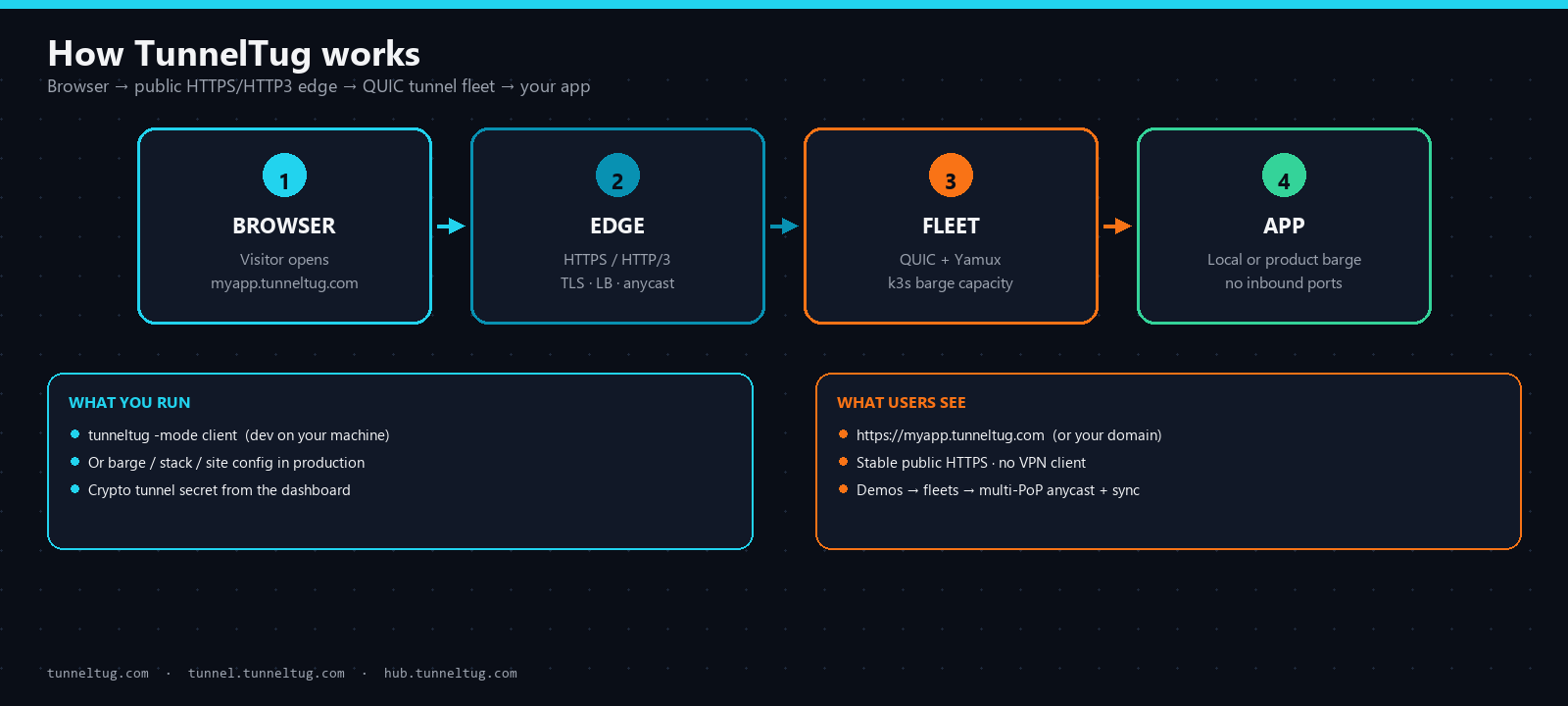
Visitors hit a public HTTP/3 edge. TunnelTug carries the request over a QUIC control tunnel to your laptop in development, or through fleets and anycast edges in production. Multi-PoP stacks replicate service data through the kernel mesh.

How TunnelTug works: browser to edge to fleet to localhost

Public face on tunneltug.com Β· control at tunnel.tunneltug.com Β· images at hub.tunneltug.com Β· site config for multi-PoP Β· anycast when you need global ingress

Start in two steps

1. Sign in

Create an account, copy your tunnel secret from the dashboard, and pick a subdomain.

Open dashboard

2. Run the client

tunneltug -mode client \\
  -server tunnel.tunneltug.com \\
  -domain tunneltug.com \\
  -subdomain myapp \\
  -local 3000 \\
  -token \"$TUNNELTUG_TOKEN\"

Then open https://myapp.tunneltug.com. Grow into fleets, site config, and anycast when you are ready. Read the docs β†’ Β· Architectures β†’ Β· Hub config builder β†’